October 03, 2005
Market growth and advocacy at the Muni Wireless conference
At 150 people were expected, but over 350 people came to the San Francisco Muni Wireless conference.
At the keynote session, Esme Vos shared the results of a market study predicting a $400 million market by 2007. The point person on San Francisco's TechConnect project described the goals of Mayor Newsom's plan to unwire the city.
Jim Baller and Harold Feld put the policy issues in the context of a long fight against incumbent-led restrictions, and the related need for open spectrum.
In a breakout session Laura Arnold of Indiana and I talked about defeating state-level muni broadband bans. In Indiana, the municipal association came out against the bill early, and it died a quiet death. In Texas the fight was longer and tougher, but strong support from the high-tech industry and Texas communities prevented the passage of a municipal broadband ban.
It was great to hear the cheers in the room responding to a vision of connectivity for all, and it was encouraging to hear the shared assumption that governments have the right and the duty to provide civic infrastructure.
September 18, 2005
Texas Community Networks support Katrina Relief
Volunteers from the Texas community and municipal network community have been helping to organize communications for hurricane evacuees.
Technology For All is a non-profit that provides wireless networks to help bridge the digital divide in partnership with the city of Houston and Rice University. TechForAll worked with its community and corporate partners to set up a Community Technology Center at Houston's Astrodome. The technology center set up its public access WIFI to help evacuees reconnect with missing friends and family.
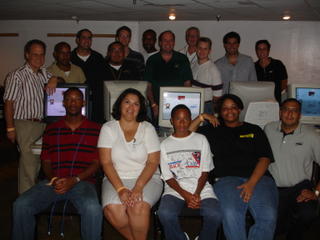
The team at the Northeast Texas Wireless initiative coordinates public-private partnerships to link towns in Northeast Texas and North Louisiana. The NETWI team provided a wireless workstation to connect evacuees in Atlanta, Texas.
The NETWI team also worked with Kenny Bain of Fastline Internet, a wireless ISP, and Glen Thompson, a volunteer from Colorado who drove down to help set up internet access stations at shelters. In this picture, Glen, Dave from N.E.T.W.I. and Kenny Bain with Fastline Internet are setting up a 'node' at Town Hall in Vivian, Louisiana.

In Austin, the City of Austin worked with Austin Freenet to organize computer stations and help connect evacuees with missing relatives and assistance. Chip Rosenthal of SaveMuniWireless was part of the team helping coordinate technology for the relief efforts.
More stories about community wireless support for the relief efforts in Louisiana can be found here
August 24, 2005
No Role for Munis
The Fort Worth Startlegram has an article on the battle for municipal networks in Texas (annoying registration required).
The article introduces the issue by telling the story of Addison. No incumbent provider wanted to deploy broadband in the city. So the city sought out a vendor to deploy a wireless network.
The article continues to discuss the recent legislative battle over muni networks.
"I've had some municipal folks say, 'Well, we want to bridge the digital divide, and the Internet is too expensive,'" said Rep. Phil King, R-Weatherford. "Well, cars are too expensive. Should cities open up car dealerships and sell them cheaper? What about groceries? Should the city get involved with that? I think they look at it as a utility. It's just such a slippery slope."
King questioned how fair it was for a company to invest heavily in a region and then have a city recruit competition that charges reduced rates.
In introducing legislation that would overhaul much of Texas' telecommunication laws during the last legislative session, King spearheaded a movement to include a ban of municipal wireless networks. The ban was struck from the bill, which the Legislature has since passed and is awaiting Gov. Rick Perry's signature.
"Talk about opening a can of worms," King said. "We did not realize a lot of cities were already doing this. From a legislative perspective, it was like the toothpaste was already out of the tube."
Somebody needs to let Rep. King know that cities have the right to setup bus service and food banks if they choose. Maybe if Ford and H-E-B hired some more lobbyists, they could seek the same protections that the incumbent telcos want.
August 19, 2005
Corpus Christi joins the Digital Communities
Intel has launched a Digital Communities initiative, to help municipalities obtain the information they need to successfully deploy new broadband technologies. Corpus Christi is one of the three communities world-wide chosen to highlight the benefit of these new broadband services.
One of the novel aspects of the Corpus Christi network is the focus on mobile access. The impacts are widespread, from improved public safety to reducing the cost of meter reading.
In the case study overview (284KB PDF), Intel says about Corpus:
The 281,000 citizens of Corpus Christi will be able to access many city services online, and the city expects benefits in the areas of education, economic vitality and lower crime rates. Approximately 70 percent of the city's 3,100 employees work in the field and will benefit from dozens of planned mobile solutions. These advantages will also extend to the many employees of county, port authority, state and federal departments who work in the community.
Read more at Red Herring. (The Corpus Christi paper also has an article, but it's hidden behind a registration page.)
Call to Veto SB 5
Free Press has just issued an action alert for all concerned Texans to call Governor Perry and ask him to veto the telecom bill. While the harmful muni wireless provisions have been stripped, what remains is still very bad for Texans and our communities.
If you are concerned about the future of broadband communications in Texas, please take a moment to view the action alert. It will tell you everything you need to place a quick phone call to register your opposition.
As far as the now concluding special session, here is a choice quote that seems to sum it all up:
Lobbyists are driving the train rather than having a philosophically driven, policy-driven plan.
– former Texas GOP Chairman Tom Pauken.
August 11, 2005
Devastating Critique of US Broadband Policy
How many megabits should a broadband connection be? One? Ten? Fifty? (Your 802.11g wireless network runs at 50Mbps.) A thousand? (That's fiber-class gigabit networking.)
Turns out that the FCC currently defines broadband as a mere fraction of that speed. Two tenths of a megabit! And in one direction only! That's hardly faster than a dialup modem.
That's one of the findings of a recently released report (1.2MB PDF) that documents the poor state of the US broadband market, and explains why the rosy picture being painted in Washington (and the Austin Capitol) doesn't match reality.
Esme has a good overview of the findings.
Telecom Passes to Governor
Yesterday, the telecom bill passed out of the House 144 to 1, over the opposition of consumer, community, and industry groups. (We signed onto a letter to state leaders in opposition to this legislation.)
Although we find much to dislike about this bill, we're pleased that it remains free of barriers to community Internet. It is now on its way to the Governor.
Read more at Dallas Morning News and Austin American-Statesman.
August 09, 2005
Telecom Moving Forward
Today, the telecom bill was passed out of the state Senate, and debated but not voted in the House. Passage is expected tomorrow.
Read more at the San Antonio Express-News. (Via Kuff.)
Southlake Approves Public Wireless
Last week, the City of Southlake approved funding for a pilot project to provide public access wireless Internet. $72,846 has been approved to fund six public hotspots. The network also will be used for public safety. The contract was awarded to Red Moon, the same company that will be operating the city-wide mesh in Addision.
Read more at the Dallas Morning News. (Via Esme and Glenn.)
Telecom May Return
Reports are circulating that the legislature will take up a stopgap school financing measure today, and follow that with the long simmering telecom legislation.
The current SB 5/HB 13 language does not contain the community Internet prohibitions that concerned us. Nonetheless, Save Muni Wireless is opposing this legislation.
We are concerned that on the greater issue of broadband availability, the proposed legislation does nothing to increase the number of broadband competitors in Texas. We also are concerned about the risk to community networks by the actions of a tired and weary legislature, rushing to push through this sweetheart legislation.
Community interest groups are planning a press event this morning, to ask state leaders to oppose this hurried, special interest legislation. Save Muni Wireless will be participating.
Please contact your state representatives today and ask them to reject the rush to special interest legislation.